RumorGuard
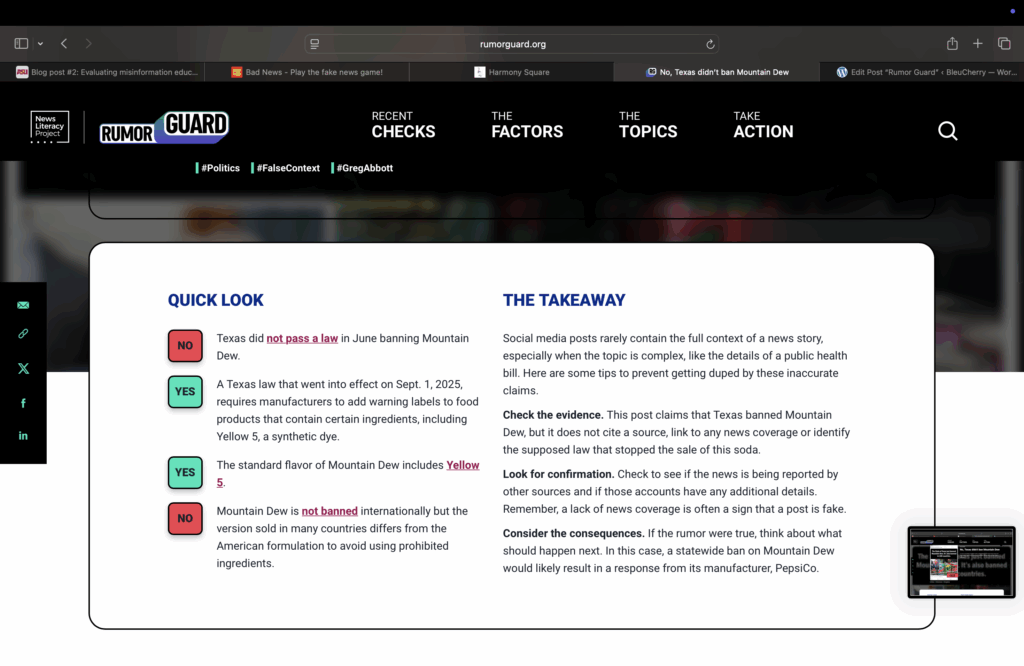
The first tool I explored was the News Literacy Project’s RumorGuard, which is basically a fact-checking service that helps people sort through viral posts and questionable headlines. The way it works is simple: you scroll through recent claims that are making the rounds online, and RumorGuard breaks them down one by one. Each claim comes with an explanation of whether it’s true or false, and they provide evidence from credible sources to back it up. The tool also gives a quick summary of why something is misleading and offers tips on how to recognize similar red flags in the future.
What I liked about RumorGuard is that it makes fact-checking really approachable. Instead of having to dig through academic sources or hunt for multiple articles, everything is laid out clearly in one spot. I could see this being useful for everyday people who don’t have time to do deep research but still want to make sure they’re not falling for misinformation.
As far as effectiveness, I’d say it works well in teaching the basics of media literacy. It’s not necessarily interactive in a “game” sense, but I think the straightforward design makes it practical. You can learn how misinformation works by seeing it applied in real examples that you probably recognize from your own social feeds. It definitely made me think more critically about how often I should be double-checking information before sharing it.
In general, I think tools like this are really important because misinformation thrives on speed posts get shared faster than people take the time to verify them. Having a quick and trustworthy resource to slow people down is a good step toward making online spaces a little less chaotic.

Bad News and Harmony Square
For the second part of the assignment, I actually ended up playing two games: Bad News and Harmony Square. Both had the same general idea you step into the shoes of someone spreading misinformation but they approached it in slightly different ways.
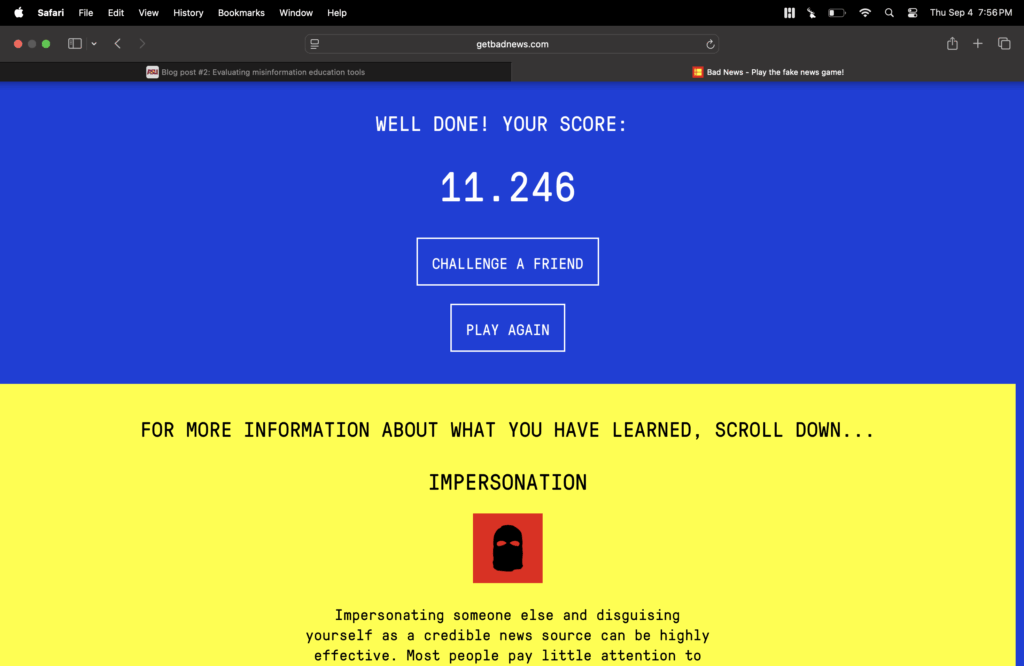
In Bad News, you act as a kind of shady blogger trying to grow a following by spreading fake content. The game teaches you about six key techniques used in misinformation: impersonation, emotion, polarization, conspiracy, discrediting, and trolling. Each round introduces a new technique, and you get to choose how you want to apply it. I ended up with 11,246 followers by the end, which I don’t think is a huge number compared to what’s possible, but it was interesting to see how my decisions influenced growth. At first, I was confused and didn’t get many followers, but once I started choosing more radical responses, my numbers went up. Even though it was just a game, it felt a little wrong picking the most outrageous, polarizing answers. But that was also the point it showed how quickly things can spiral when misinformation is pushed in extreme ways.
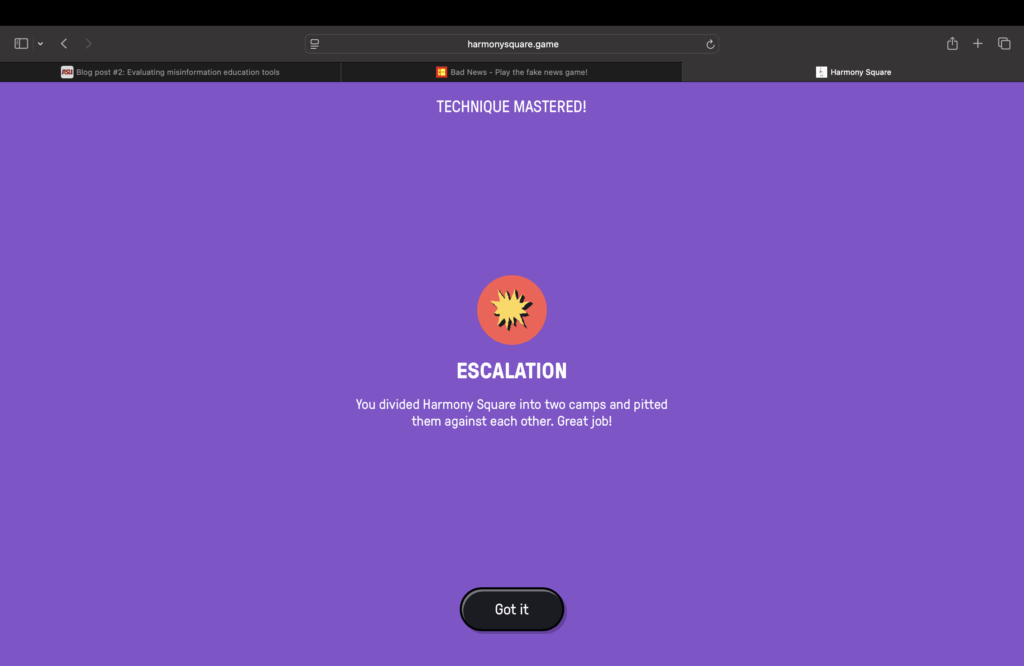
Harmony Square took a more humorous route. Instead of a generic blog, you’re spreading disinformation in a quirky little town. My outcome was that I “mastered” the technique of escalation, which made sense because I kept choosing the most outlandish options. The whole thing was funny on the surface, but the underlying lesson was serious: once misinformation starts to escalate, it becomes very difficult to stop. The game highlights how easy it is to polarize a community and get people worked up over fake or exaggerated claims.
What struck me the most in both games was how real it all felt. Obviously, I wouldn’t ever do this in real life, but watching how fake accounts, bots, and inflated follower counts make something look credible was eye-opening. It reminded me of how often people assume information is true just because it comes from a page with a check mark or lots of followers. These games really drive home the point that credibility isn’t the same thing as popularity.
Overall, I think educational games like these are surprisingly effective. They don’t just tell you about misinformation they make you practice creating it, which makes the lessons stick in a different way. Even though it felt morally uncomfortable to play, I walked away with a better understanding of how manipulative strategies work and why people fall for them. I think tools like this are valuable because they combine learning with interactivity, and that makes the experience more memorable than just reading an article or watching a lecture.
Leave a Reply